Showing posts with label Red Skelton. Show all posts
Friday, June 29, 2012
Wednesday, May 30, 2012
MGM Stars
They say that MGM had more stars than heaven did, and guess what, I found this rare picture of the stars of MGM, celebrating Louis B Mayer's birthday! Okay, actually, this photo is available everywhere, but I never typed those keywords. That's the problem with the Internet: you have to know what you are finding; there's no such thing as random browsing.
Anyway, here it is:
I love Lucy!Anyway, here it is:
I've always known that Lucille Ball is in this picture (I mean, look at her symbolic red hair!), but someone from Instagram told me that her husband Desi Arnaz was in the picture too! That made me so excited! Can you spot him?
Here are some photos from @welovelucilleball at Instagram for you to grab:
Front Row: James Stewart, Margaret Sullavan, Lucille Ball, Hedy Lamarr, Katharine Hepburn, Louis B Mayer, Greer Garson, Irene Dunne, Susan Peters, Ginny Simms, Lionel Barrymore
Second Row: Harry James, Brian Donlevy, Red Skelton, Mickey Rooney, William Powell, Wallace Beery, Spencer Tracy, Walter Pidgeon, Robert Taylor, Pierre Aumont, Lewis Stone, Gene Kelly, Jackie Jenkins
Third Row: Tommy Dorsey, George Murphy, Jean Rogers, James Craig, Donna Reed, Van Johnson, Fay Bainter, Marsha Hunt, Ruth Hussey, Marjorie Main, Robert Benchley
Fourth Row: Dame May Whitty, Reginald Owen, Keenan Wynn, Diana Lewis, Marilyn Maxwell, Esther Williams, Ann Richards, Marta Linden, Lee Bowman, Richard Carlson, Mary Astor
Fifth Row: Blanche Ring, Sara Haden, Fay Holden, Bert Lahr, Frances Gifford, June Allyson, Richard Whorf, Frances Rafferty, Spring Byington, Connie Gilchrist, Gladys Cooper
Sixth Row: Ben Blue, Chill Wills, Keye Luke, Barry Nelson, Desi Arnaz, Henry O'Neill, Bob Crosby, Rags Ragland
Here are some photos from @welovelucilleball at Instagram for you to grab:
Sunday, April 22, 2012
Reason I Love Lucy: The Art of Mime
Mime, or pantomime, is the performing art of expressing scenarios or motive without the use of speech. Though to be distinguished from silent comedy, I find the both genres overlapping into a blend of grey area.
It's very sad that the traditional forms of comedy have all vanished, and in replacement are jokes consisting of sex, violence, drugs and swear words, otherwise known as blue comedy. These days, people cannot differentiate what's funny from what's not: they are conditioned to laugh for the sake of laughing, not because of the quality of the jokes.
It is not widely know, but the genres of comedy go far and beyond, back to the ancient times when the aristocratic or the bored needed to be entertained by gladiators or in amphitheaters, the 1800s where vaudevillian performances were popular, the early 1900s where silent comedy, slapstick comedy, prop comedy, physical comedy and pantomime were immensely well-received by people, and the late 1900s, where people had an appreciation for jokes with word-play and punch lines. Now, at least spoofs are still widely popular.
I remember being vastly terrified by clowns and pantomimists who painted their faces white and their lips blood red when I was a little girl. However, as I got to sit through a particular performance, I was amazed by how these comedy actors could convey a message to the audience without uttering a single word! I gazed around, and realized that all the kids were roaring with laughter! Now, bear in mind that kids are taught what's funny and what's not by their caregivers and peers; how in the world did the comedy artists make them laugh without the kids having prior preconceptions to miming?
Having uncovered this fascinating fact, I became so in awe of these talented people that I was intimidated. Once, a pantomimist talked to me after he removed his makeup, and even then, I stuttered my way through the conversation. I was puzzled by his previous clowning around with his makeup and his total contrasting personality of being deadpanned serious without! Now that I've lived a ripe old age, I still don't think I'll muster enough nerve.
Now, this is why we have to differentiate between a comedy actor and a comic from a comedian. A comedy actor acts comedy out, a comedian creates a persona of comedy. As the famous Ed Wynn once said, "A comic says funny things, a comedian says things funny." That really offered explanations to me why the pantomimist had two split personalities.
If you don't comprehend the importance of the need for distinction of comedy actor/comic from a comedian, take Mr. Bean for example. I'm sure you've all rolled on the ground, overwhelmed by uncontrollable laughter due to the physical comedy showcased in the television series. Would you then believe that in real life, Rowan Atkinson is a dead serious man? He'll be your typical serious politician, stern principal, or reserved banker. Seeing a person with such contrasting personalities on and off screen can be a rather bemusing experience for a clueless stranger. However, we should never create an expectation of wanting them to make us laugh when they're not assuming a particular character. It's not only grossly unfair, it is terribly taxing for them too- imagine the diminishing of pride if they feel that they've let people down. Therefore, the need to distinguish the two genres of acting is critical!
There were other well-known comedy actors back in the late 1800s and early 1900s, where vaudeville was at its peak and then regressed. The unavailability of sound in films really helped to promote silent comedy! In the lasts years of the 19th century, Charles "Charlie" Chaplin, Harold Lloyd and Buster Keaton were the three comedic giants. I'm thankful that many of their great films are still available today, though the picture quality sure is poor. When I'm feeling down, I'll just visit Charlie Chaplin and his silly antics have the power to cheer me up. Then, in the early and mid 20th century, Harpo Marx (of the Marx brothers), Red Skelton and Robert "Bob" Hope appeared in films and theaters. Their natural talents helped retain the connection to the old but much revered forms of comedy.
Are men naturally more talented in comedy? Are females more restrained and more afraid to lose their glamor if they get a pie thrown in their faces? For some reason, all the comedy actors are male, with one exception...
LUCILLE BALL!
Before Lucille became known as the ditzy screwball redhead, she was a glamor queen in films. Her roles ranged from serious acting, to femme fatale or detective of film noirs, to the girl who always didn't get her man, to the brass-knuckled burlesque queen, to the bitch who learned her lesson but died. She was one of the most talented people who ever graced the earth. It's like a combination of Nicole Kidman, Angelina Jolie, Rachel McAdams, Sandra Bullock, Christina Aguilera, and Helena Bonham Carter! No Hollywood actors today has even one tenth of the talent that this wonderful lady possessed. No one can combine all these actresses' specialties together except Lucille.
The directors and presidents of film production companies like RKO, MGM, 20th Century Fox, Universal Studios, Paramount Pictures, Columbia Pictures and Warner Bros. Pictures were perplexed, they did not know where to place her: she fit in everywhere, she was a misfit everywhere. No one, not even Lucille herself, knew her great comedic talent. She only knew she was tired of being the gorgeous glamorous Hollywood actress dressed in mink coats, gowns and jewelry, and was itching to have a pie thrown in her face. Having no future prospects of becoming an A actor, she finally mustered the courage to step out of the movie industry and experiment with television. It was a blessing in disguise, because she was the best and only female comedy artist, ever!
Meet America's favorite redhead:
Lucille Ball was talented in all the forms of comedy. She was a vaudevillian, a physical comedy actor, an accomplished mummer and pantomimist, silent comedienne and a slapstick and prop comedy actor with no prior serious training. She observed, she asked, she learned, she rehearsed, and she became alive!
In my opinion, and with all due respect, no giant of physical comedy, except probably Charles Chaplin was on par with her. Additionally, she was so funny that people conveniently forgot that she was one of the most beautiful women on earth. Buster, Harold, Harpo and Red were all geniuses, but Lucille had something special: when others couldn't, she was the only one who could connect with the audience. They not only laughed at her, with her, they loved her. That's the X-factor that no other giant had.
It's impossible to go back in time, where there were great Hollywood actors who gave their very best in all performances, and who made great friendship and helped one another boost their careers.
It's another issue altogether today...
It's very sad that the traditional forms of comedy have all vanished, and in replacement are jokes consisting of sex, violence, drugs and swear words, otherwise known as blue comedy. These days, people cannot differentiate what's funny from what's not: they are conditioned to laugh for the sake of laughing, not because of the quality of the jokes.
It is not widely know, but the genres of comedy go far and beyond, back to the ancient times when the aristocratic or the bored needed to be entertained by gladiators or in amphitheaters, the 1800s where vaudevillian performances were popular, the early 1900s where silent comedy, slapstick comedy, prop comedy, physical comedy and pantomime were immensely well-received by people, and the late 1900s, where people had an appreciation for jokes with word-play and punch lines. Now, at least spoofs are still widely popular.
I remember being vastly terrified by clowns and pantomimists who painted their faces white and their lips blood red when I was a little girl. However, as I got to sit through a particular performance, I was amazed by how these comedy actors could convey a message to the audience without uttering a single word! I gazed around, and realized that all the kids were roaring with laughter! Now, bear in mind that kids are taught what's funny and what's not by their caregivers and peers; how in the world did the comedy artists make them laugh without the kids having prior preconceptions to miming?
Having uncovered this fascinating fact, I became so in awe of these talented people that I was intimidated. Once, a pantomimist talked to me after he removed his makeup, and even then, I stuttered my way through the conversation. I was puzzled by his previous clowning around with his makeup and his total contrasting personality of being deadpanned serious without! Now that I've lived a ripe old age, I still don't think I'll muster enough nerve.
Now, this is why we have to differentiate between a comedy actor and a comic from a comedian. A comedy actor acts comedy out, a comedian creates a persona of comedy. As the famous Ed Wynn once said, "A comic says funny things, a comedian says things funny." That really offered explanations to me why the pantomimist had two split personalities.
If you don't comprehend the importance of the need for distinction of comedy actor/comic from a comedian, take Mr. Bean for example. I'm sure you've all rolled on the ground, overwhelmed by uncontrollable laughter due to the physical comedy showcased in the television series. Would you then believe that in real life, Rowan Atkinson is a dead serious man? He'll be your typical serious politician, stern principal, or reserved banker. Seeing a person with such contrasting personalities on and off screen can be a rather bemusing experience for a clueless stranger. However, we should never create an expectation of wanting them to make us laugh when they're not assuming a particular character. It's not only grossly unfair, it is terribly taxing for them too- imagine the diminishing of pride if they feel that they've let people down. Therefore, the need to distinguish the two genres of acting is critical!
There were other well-known comedy actors back in the late 1800s and early 1900s, where vaudeville was at its peak and then regressed. The unavailability of sound in films really helped to promote silent comedy! In the lasts years of the 19th century, Charles "Charlie" Chaplin, Harold Lloyd and Buster Keaton were the three comedic giants. I'm thankful that many of their great films are still available today, though the picture quality sure is poor. When I'm feeling down, I'll just visit Charlie Chaplin and his silly antics have the power to cheer me up. Then, in the early and mid 20th century, Harpo Marx (of the Marx brothers), Red Skelton and Robert "Bob" Hope appeared in films and theaters. Their natural talents helped retain the connection to the old but much revered forms of comedy.
Are men naturally more talented in comedy? Are females more restrained and more afraid to lose their glamor if they get a pie thrown in their faces? For some reason, all the comedy actors are male, with one exception...
LUCILLE BALL!
Before Lucille became known as the ditzy screwball redhead, she was a glamor queen in films. Her roles ranged from serious acting, to femme fatale or detective of film noirs, to the girl who always didn't get her man, to the brass-knuckled burlesque queen, to the bitch who learned her lesson but died. She was one of the most talented people who ever graced the earth. It's like a combination of Nicole Kidman, Angelina Jolie, Rachel McAdams, Sandra Bullock, Christina Aguilera, and Helena Bonham Carter! No Hollywood actors today has even one tenth of the talent that this wonderful lady possessed. No one can combine all these actresses' specialties together except Lucille.
The directors and presidents of film production companies like RKO, MGM, 20th Century Fox, Universal Studios, Paramount Pictures, Columbia Pictures and Warner Bros. Pictures were perplexed, they did not know where to place her: she fit in everywhere, she was a misfit everywhere. No one, not even Lucille herself, knew her great comedic talent. She only knew she was tired of being the gorgeous glamorous Hollywood actress dressed in mink coats, gowns and jewelry, and was itching to have a pie thrown in her face. Having no future prospects of becoming an A actor, she finally mustered the courage to step out of the movie industry and experiment with television. It was a blessing in disguise, because she was the best and only female comedy artist, ever!
Meet America's favorite redhead:
Lucille Ball was talented in all the forms of comedy. She was a vaudevillian, a physical comedy actor, an accomplished mummer and pantomimist, silent comedienne and a slapstick and prop comedy actor with no prior serious training. She observed, she asked, she learned, she rehearsed, and she became alive!
In my opinion, and with all due respect, no giant of physical comedy, except probably Charles Chaplin was on par with her. Additionally, she was so funny that people conveniently forgot that she was one of the most beautiful women on earth. Buster, Harold, Harpo and Red were all geniuses, but Lucille had something special: when others couldn't, she was the only one who could connect with the audience. They not only laughed at her, with her, they loved her. That's the X-factor that no other giant had.
It's impossible to go back in time, where there were great Hollywood actors who gave their very best in all performances, and who made great friendship and helped one another boost their careers.
It's another issue altogether today...
Sunday, February 26, 2012
Du Barry was a Lady (1943)
Here's a review on a old Hollywood musical film, an adaptation from Broadway: Du Barry Was a Lady.
Before composing the review, I would like to discuss the feud between Hollywood and Broadway. Without saying, many would prefer the original Broadway version to the film version. It's just a whole different experience to watch a play as live audience-- certain emotions cannot be procured in a movie theatre. Sometimes I do wonder why Hollywood would want to purchase film rights from Broadway to make those unparalleled musicals into movies. Sure, it is a guaranteed way to earn money from us movie-goers-who-choose-to-watch-movies-instead-of-Broadway-musicals-due-to-budget-constrains, but can they stand the disgruntled rotten tomatoes? Look at how full of angst fans of Phantom of the Opera exuded.
Nevertheless, I'm biased when it comes to Lucille Ball. But objectively speaking, she's the type of actress who whenever presented with a weak script, would come out of the script and make the plot alive. She's the kind of a person who would give 120% when only 100% is required of her. Even movie critiques and professional reviewers concur these statements (I've read those statements!). And we all know how harsh and brutal these experts could be.
"Now I'm not falling for anyone until I see the whites of their checkbooks."
Lucille Ball was cast as May Daly/ Madame Du Barry
Red Skelton was cast as Louis Blore and Louis XV
Gene Kelly was cast as Alec Howe and The Black Arrow
So the story goes like this: May Daly is a talented and beautiful nightclub singer. She vows not to fall in love with a man with no dough after seeing how hard her parents had to work to survive in the harsh city of New York. Both employees in the nightclub, Louis Blore and Alec Howe are deeply in love with her. Of course, May Daly loves Alec, but because he is virtually penniless, she chooses to subdue her feelings for him. One day, Louis wins the Irish Sweepstakes and becomes a millionaire overnight. He proposes to May Daly, who accepts it. May Daly makes it clear to Louis that she isn't in love with him, but she says her yes because he can provide her stability. Louis accepts it, and fervently believes that he can win her heart one day.
Louis is accidentally slipped a mickey and he falls into a deep sleep. He dreams he is the corrupted King Louis XV, who uses all his money from extorting the peasants to woo the impossibly demanding and selfish Madame Du Barry who is May Daly, and Alec is The Black Arrow, the hero who wants to assassinate the tyrant king. After a series of slapstick comedy, Louis wakes up from the dream and realizes that money cannot buy love. May Daly finally awakes from her stupid philosophy and decides to marry Alec, and the story ends on the typical happily-ever-after note.
A side note: I just realize how well I can write a synopsis!
From the summary, you could see how tough it is for an actress to take up the role of May Daly or Madame Du Barry. One would first need to get all gussied up for the role of a perfectly groomed singer in a nightclub; that kind of sophisticated and serious woman who is hard to get. Then, one would need to be recast into a selfish and demanding queen, and be spun into a series of crazy comedic routines that would make the character a complete antithesis of the nightclub singer. I must proclaim that with such a tough role, only Lucille Ball would be able to take it up. Maybe Sandra Bullock can do it too.
I love the movie not just because of Lucy, not just because of Gene Kelly, but also because the songs were all written by Cole Porter. I love "Friendship". And my favorite number is "Do I Love You." It just melts my heart! The lyrics, the melody and the rhythm, the answer of "Yes, I do love you" is just encapsulated in the song.
Do I love you, do I? Doesn't one and one make two?
Do I love you, do I? Does July need a sky of blue?
Would I miss you, would I? If you should ever go away?
If the sun should desert the day, what would life be?
Will I leave you, never? Could be ocean leave the shore?
Will I worship you forever? Isn't heaven forever more.
Do I love you, do I? Oh my dear, it's so easy to see.
Don't you know I do, don't I show you I do just as you love me.
I guess this lyrics seems kind of familiar to my Twitter followers. Each time my iPod plays this song sung by Ella Fitzgerald, I'll type the lyrics out and send it to the virtual world. It's simply poetic. If someone I love were to look into my eyes, play the piano and sing this song to me, my cold heart would melt!
Gene Kelly did a phenomenal job of singing this song. His tap dance was, not surprisingly, excellent as well.
Red Skelton is without speaking, one of the best slapstick comedians ever. I think Lucy learned a lot from him! You could see hints of a future Lucy Ricardo in this movie!
Tuesday, February 7, 2012
Movie Review: Ziegfeld Follies (1946)
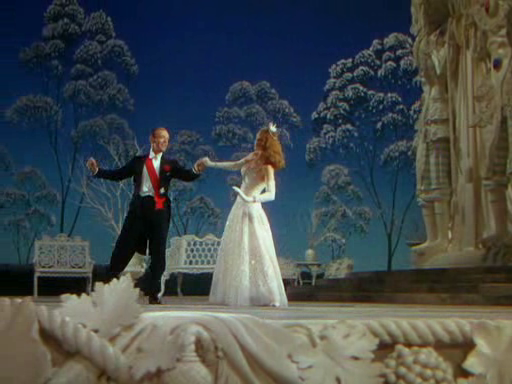
I finally had the pleasure to watch the extravagant Hollywood musical by Metro Goldwyn Mayer (MGM), Ziegfeld Follies. The movie was amazing because it starred many of MGM's greatest stars ever, including Fred Astaire, Lucille Ball, Judy Garland, Gene Kelly, William Powell, Red Skelton, Esther Williams, and many others, who I am not familiar with.
Vincente Minnelli, the father of the famous Liza Minnelli we all know today (if otherwise, watch Sex and the City 2, she sang Single Ladies), and the then husband of Judy Garland, was one of the movie directors.
Who says Hollywood cannot produce musicals like Broadway? I found Ziegfeld Follies enjoyable! MGM really proved this sweeping statement wrong.
William Frawley was one of the supporting actors in one of the acts! It's amazing how Lucille Ball and William Frawley appeared in the same movie, yet never spoke until I Love Lucy!
Fred Astaire sang Here's to the Girls, and Lucille was the princess/dancer.
She then cracked a whip over the chorus girls.
Esther William was a mermaid, dancing underwater. Of course, she was wearing waterproof make up.
Another highlight of this musical was Fred Astaire dancing with Lucille Bremer. They were magnificent together. Dancing on the moving treadmills and rotating floors was so breathtakingly exciting!
In fact, Lucille Bremer was Fred's dance partner in 3 of his best routines.
Judy Garland was... Judy Garland-ish.
What can I say? She was a great dramatic actress and a great singer. And being gorgeous helped much!
I couldn't wait to see Fred and Gene Kelly together. Indeed, their number was great. Seeing the two men together was an awesome feeling-- they could dance, tap dance and sing equally well!
I long for happy peppy musicals or movies where all the Hollywood people come together to strut their stuff. But today's stars have too huge an ego to star together with others of the same status and popularity. Even if they have movies of this sort, somehow, they suck. I don't know what people think of New Year's Eve (starring Katherine Heigl, Zac Efron, Sarah Jessica Parker, Ashton Kutcher, Josh Duhamel, Jessica Biel, etc, etc), it most certainly didn't suck, but it wasn't hands-down wonderful too. One might think that he wouldn't be disappointed with all the wonderful celebrities around, but one was wrong.
Hollywood stars back then were irrefutably talented. They could dance, sing and act. Even if they could do none of these, they at least looked drop dead gorgeous. Nowadays, too many Hollywood celebrities can do none of the above. Some of them aren't even good looking, without the stage make up and all. Of course, there are exceptions! I'm crossing my fingers and hoping that more talents would emerge.
For fans of splashy musicals from the 1940s, Ziegfield Follies is a must watch!
Vincente Minnelli, the father of the famous Liza Minnelli we all know today (if otherwise, watch Sex and the City 2, she sang Single Ladies), and the then husband of Judy Garland, was one of the movie directors.
Who says Hollywood cannot produce musicals like Broadway? I found Ziegfeld Follies enjoyable! MGM really proved this sweeping statement wrong.
William Frawley was one of the supporting actors in one of the acts! It's amazing how Lucille Ball and William Frawley appeared in the same movie, yet never spoke until I Love Lucy!
Fred Astaire sang Here's to the Girls, and Lucille was the princess/dancer.
She then cracked a whip over the chorus girls.
Esther William was a mermaid, dancing underwater. Of course, she was wearing waterproof make up.
Another highlight of this musical was Fred Astaire dancing with Lucille Bremer. They were magnificent together. Dancing on the moving treadmills and rotating floors was so breathtakingly exciting!
In fact, Lucille Bremer was Fred's dance partner in 3 of his best routines.
Judy Garland was... Judy Garland-ish.
What can I say? She was a great dramatic actress and a great singer. And being gorgeous helped much!
I couldn't wait to see Fred and Gene Kelly together. Indeed, their number was great. Seeing the two men together was an awesome feeling-- they could dance, tap dance and sing equally well!
I long for happy peppy musicals or movies where all the Hollywood people come together to strut their stuff. But today's stars have too huge an ego to star together with others of the same status and popularity. Even if they have movies of this sort, somehow, they suck. I don't know what people think of New Year's Eve (starring Katherine Heigl, Zac Efron, Sarah Jessica Parker, Ashton Kutcher, Josh Duhamel, Jessica Biel, etc, etc), it most certainly didn't suck, but it wasn't hands-down wonderful too. One might think that he wouldn't be disappointed with all the wonderful celebrities around, but one was wrong.
Hollywood stars back then were irrefutably talented. They could dance, sing and act. Even if they could do none of these, they at least looked drop dead gorgeous. Nowadays, too many Hollywood celebrities can do none of the above. Some of them aren't even good looking, without the stage make up and all. Of course, there are exceptions! I'm crossing my fingers and hoping that more talents would emerge.
For fans of splashy musicals from the 1940s, Ziegfield Follies is a must watch!
Subscribe to:
Posts (Atom)