Showing posts with label Autobiography. Show all posts

Tuesday, May 22, 2012

Love, Lucy and A Book

It seems like Heaven wants to reward us earthlings by giving us a reason to laugh heartily. It was simply fate that an American and a Cuban who lived so far away would meet, marry and eventually create I Love Lucy. I'm really thankful for this sitcom because I've made it a habit to watch I Love Lucy whenever I am feeling angry, troubled or sad. It works like magic every single time. I'm sure many of you do the same thing too!

It wasn't by sheer coincidence that they two wonderful people finally conceived a baby just before I Love Lucy, and another during the end of the first season. You could feel their desire/obsession to want children by reading their autobiographies: Love, Lucy, and A Book. A child is a gift unique to the couple, and they both wanted to cement the marriage by all means.

Here are extracts from the autobiographies, and they fit together like a jigsaw puzzle! I really, really, really recommend these two books, because not only do they make an enjoyable read, the stories that come from the horses' mouths are the most legitimate!


Lucille Ball: Love, Lucy
I wanted him and only him as the father of my children.

...

In 1949, Desi and I instituted a "stay at home" policy. I was still childless, which caused me great heartache. Freddy (her brother) and Cleo (her cousin) were both married and had kids of their own; I had dogs and cats. So one day, Desi and I sat in our cabbage-rose-papered living room and talked far into the night. We finally decided that Desi would give up his cross-country tours and only take local engagements with his band. We would both consult doctors to see why we did not have children.

Desi Arnaz: A Book
The reason we hadn't had a child was not because we weren't trying. We were doing everything humanly possible to have one. I'll never forget the day I had an appointment with one doctor. Maybe it was my fault, I thought. 


"I have to have your semen count," he told me, "so go into the bathroom back there, take this little bottle and put your semen in it."


"Wait a minute," I said. "How?"


"Masturbate, and when the orgasm comes make sure it flows into this bottle here."


"I'm getting a little too old for that, Doc. Couldn't one of the nurses help?"


"Never mind," he said, "you're on your own."


I went into the bathroom and told myself, "Well, you gotta do it, so do it."


Fire engines and police sirens going by on the street below did not help my chore any. The result was that there was no physical reason why I couldn't be a father. Lucy had already been examined and there was nothing wrong with her either.


I'm so glad that their wish came true. Not only were they rewarded with Lucie Arnaz, they had Desi Arnaz Jr. to carry on the family line.
Tuesday, February 7, 2012

Love, Lucy

Lucille Ball had been reluctant in writing her autobiography; she had always did all she could to protect her family members. She felt that what she would recall about the marriage would hurt Desi.

Her doctor suggested that she write one, "it would be emotionally healing," he had said.

No one knew that Lucille Ball had followed her doctor's advice into writing one. It was only many years after her death that her daughter Lucie Arnaz found the scripts amongst other official papers.

Desi had written an autobiography and it was sad that Lucy didn't. "I should have known," Lucie Arnaz said. "Dad and mum have always insisted on a happy ending."

I'm glad that Lucille Ball did. It really shed lots of light on why she was the way she was, and why she became bitter and hard when she grew old. Beneath that unapproachable demeanor laid a poor soul who had been hurt beyond healing.

Friday, November 18, 2011

Hearts Made of Gold

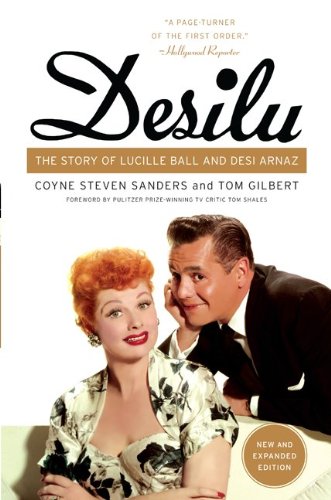
The book Desilu: The Story of Lucille Ball and Desi Arnaz was a very tough read for me. It took me some time to recover from the evident pain so many people suffered.

Seeing how bitter, unreasonable and angry Lucille had turned into, and how completely self-destructive Desi had become after their divorce were like punches after punches into my face. I suggest fans to read their individual autobiographies

A Book by Desi Arnaz

Love, Lucy by Lucille Ball

before diving into Desilu: The Story of Lucille Ball and Desi Arnaz, because there were too many factors that changed the both of them, factors that were such big blows, that it is impossible for one to recover from.

If only they had left their fame behind and had gone somewhere else completely secluded to start anew, things wouldn't have turned out this way.

Bear in mind that Lucille Ball and Desi Arnaz were the nicest, sweetest people around. Desi was simpler to analyze: he was outwardly nice and sweet. Lucille was complicated: one has to own a sharp pair of eyes and a keen sense of perception to feel her niceness and sweetness.

Working for a boss like Desi was a man's greatest dream. He treated each and every one of his employees humanely. In fact, even his band members' welfare came before his. He expected honesty from his employees, and in turn, he provided generously. Even after he became the president of Desilu, he didn't become high and mighty. He was the most modest boss ever, even with his increasing addiction to alcohol.

Lucille may seem like a tough nut, or an ice queen, but she had a soft spot buried deeply in her. Over the course of her marriage, she had experienced the indescribable heartache of not one, but three miscarriages. She wanted nothing as much as having a child that belonged to Desi and herself, but thrice, that child slipped away from the both of them. Her earliest scrapbooks consisted of adorable pictures of babies with endearing notes expressing her longing for a child.

No one could communicate that indescribable heartache of a miscarriage than one who has had a miscarriage herself:

Shortly after recovering from a miscarriage, Lucille heard the news that Desi and her longtime friend, Marcella Rabwin, too suffered from a miscarriage. Marcella was depressed the entire time in the hospital. She wouldn't speak to anyone, and her room was always kept dark and quiet. The lost of a baby was so traumatizing. Lucille forgot about her own loss and rushed to the hospital. She didn't knock on the door; she just opened the door as unobtrusively as possible to let herself in, fully clothed. She didn't say a word, not even a hello. She started unbuttoning her blouse, and to Marcella's surprise, Lucille did a comical striptease for her. And the ever depressed Marcella laughed uproariously- the first time she had laughed throughout the disaster. Seeing that she had helped, Lucille then left quietly, expecting no words of gratitude and giving no words of condolences. Words were not necessary.

Lucille didn't have to go out of her way. But she did. Lucille was so wonderful.

This is one of the great things that women can do for women- the capacities of a woman's love astounds me at times. And Lucille has the capacity to care and love so greatly for a friend. Imagine how she worshiped Desi then.

Those two had hearts made of gold.

Tuesday, November 15, 2011

1. Love (not) at First Sight

By the age of 28, she had been financially successful. She had achieved all that she could, having risen up from rags to riches, thanks to her strong will, hard work and indestructible determination. However, something was missing from her life, and that something was love- an enduring love, someone to care for, someone who would protect her, someone to build a home with and someone to be the father of her children.

Lucille was going to New York City, and she was told by the studio head to be sure to catch the musical named Too Many Girls on Broadway, because she might be given a starring role in the film version later on. However, she had missed the musical as she had a great fall while doing a stunt on ice for a movie which hurt her sacroliac. She had been warned against doing that stunt, but back then, she felt that she was indestructible. She spent her days in the hospital in New York recuperating from her injury and show business friends who visited her at the hospital told her that Too Many Girls was indeed a great hit, but the greatest hit was a 22 year old Cuban, Desi Arnaz. He was a charming, attractive, extremely talented and modest man and every women in the country had fallen for him. Lucy of course, wasn't impressed. She was someone who had to see it to believe it.

After recovering from her fall, Lucille finally saw the musical. Sure enough, she couldn't take her eyes off him throughout the entire musical...

"Then Desi opened his mouth and began talking in his own peculiar brand of broken English, and a great belly laugh burst out of me. Now it's hard to make me laugh. I observe, I smile, but when I'm really amused you can hear me a block away. Here was a stunning-looking male who was not only thrilling but funny. What a combination!"- Lucille Ball in her autobiography: Love, Lucy.

It is true that Lucy wasn't amused easily. She had the knack of knowing what was funny, and what would tickle people to death. She knew how to make people roar with laughter, but she seldom roared with laughter herself. There were times when even while joining in the laughter, she wasn't really amused. Isn't that amazing!

So you could imagine how intrigued she was with Desi. After 28 years of living, she finally found a potential someone who could make her laugh, laugh with no restrictions, laugh with no worrying about what was going to happen next.

Lucy went back to Hollywood, and was disappointed because she did not get the chance to be introduced to this Cuban musical talent she would later co-star with. It would be months before the director of Too Many Girls would be available to do the film version, and in the meantime, Lucy was given the starring role in a movie called Dance, Girl, Dance. Her role in the movie was a tough stripteaser in a burlesque club who often spoke sardonic remarks that were humorous in a twisted way.

One day after a few months, she was filming a scene where she had just fought with her friend from the movie and her lover had supposedly punched her. You could imagine her outfit: thick make-up, long sexy gold dress, hair down and wild, with a fake black eye.

That was how she looked like when she walked into the meeting room full of cast members, including Desi Arnaz, to say hello to the director of Too Many Girls, Mr. George Abbott. Now the cast members were all disconcerted as they looked at her from the top of her head to her toes. The role that Miss Lucille Ball was to play in the upcoming movie was an ingenue, but as Desi Arnaz described, "she looked like a two-dollar whore who had been badly beaten by her pimp, with her hair all over her face and a black eye, and she was dressed in a cheap costume". How could she play an ingenue?!

(Meaning of an ingenue: an innocent and unsophisticated young woman, according to Oxford. Or according to Desi Arnaz, an ingenue "is usually a very delicate, blond, blue-eyed girl with an innocent, virginal quality about her.")

After Lucille left, Desi immediately asked the director who the hell that woman was.

Mr Abbott answered, "that's the girl who is going to play the ingenue. That's Lucille Ball."

"That's Lucille Ball and she's gonna do the ingenue thing? You gotta be kidding," Desi's voice dripped with sarcasm and disbelief.

"Well, now, wait a minute. She was in makeup for something else right now."

"I think you've blown your top, George.There is no way they can change her back to look like an ingenue. No way."

After Lucille's shooting, she was dressed casually in tight slacks and a yellow sweater, with all traces of stage make-up removed. She had tied her blond hair neatly with a feminine bow. That was how she looked like when she walked back to the meeting room while Desi was rehearsing a song with his piano player.

Desi said to the piano player "Man, what a hunk of woman!"

His piano player was puzzled. "You met her today," he said.

"No, I never met her. I've never seen her before."

"That's Lucille Ball," his piano player said.

"THAT'S LUCILLE BALL?! You gotta be kidding. She sure doesn't look anything like she did this morning."

Desi was mesmerized. He was mesmerized, hook, line and sinker.

"Hello," Lucille said as she walked up to Desi. Of course she knew who he was; she had waited long enough to meet him, since she saw him perform back at New York.

Desi was still shocked and unsure. "Miss Ball?"

"Why don't you call me Lucille and I'll call you Dizzy."

"Okay, Lucille, but it's not Dizzy."

"Oh? How do you say it, Daisy?"

"No, Daisy is a flower. It's Desi, D-E-S-I."

Of course, he used the cheesiest line in history to invite her to dinner ("Would you like me to teach you how to Rumba? It may come in handy for your part in the movie."). She accepted.

He preferred the demure Lucille to the glamorous one, and that was the sweetest thing one could expect from a man.
They went to a nightclub, but instead of joining the conga line with the rest, they danced a while and then sat at a quiet corner and just talked and talked. They were in their own world and instant sparks flew. It was obvious even to the rest of their friends that it was love at first sight. Lucille, however, begged to differ: "It wasn't love at first sight. It took me full 5 minutes." She added on that "there was only one thing better than looking at Desi, and that was talking to him."
The night ended innocently. He drove her home, she thanked him for a wonderful evening and they said good night. 

Friends of Lucille warned her against him, that he was too young and was a playboy, but it was too late. She had fallen completely and irrevocably in love with him, and there was no turning back...

Tuesday, November 8, 2011

Stopping at Childhood

One of my postulations as to why Lucille Ball was so successful at situational comedies is that she retained a childlike way of looking at the world, at situations and at people.

Why?

I guess that all along, she had missed her carefree early childhood, when her doting father was still alive and her mother had no worries but to make the family happy. As a child, Lucy had to mature quicker than her age. She had to deal with the premature death of her father, the birth of a new baby which was a difficult adjustment for an only child, a new stepfather who treated her as if she wasn't there, being sent to an older couple who were so strict on her that she felt mentally tortured, the unlawful accusation of her grandfather which made her distrust the law forever, and many more sad events... With a life full of traumatic events, it was no wonder that a part of her stopped forever at the age of  4, where things were warm and rosy.  
As she had mentioned, in order to be convincing and to evoke knee-slapping laughter, the actor has to believe in the situation and the actions that are called for. What makes it better than to analyze the situation from a child's point of view? A child's logic is sweetly simple and naive, and it's no wonder people are always drawn to children. It's that compelling naivety that Lucille had managed to convey to the audience that makes even the most hardhearted person alive laugh endearingly.

Through her childhood and adolescence, Lucy had utilized her powers of observation. Most comedians can only work from a certain angle; Lucy could be anything and everything. She could be the doting screwball housewife, the nervous gal about to get it, the glamorous showgirl, the sexy Marilyn, the amnesic child, the clown, hell, she could even peel a potato convincingly!

Of course, having a husband Desi Arnaz with a knack for identifying what was funny and what was not, a supporting actress Vivian Vance with great chemistry, and a comedian William Frawley who was funny even just standing and doing nothing made the sitcom even more successful.